Apartment vs House: Which Is More Eco-Friendly in 2026?
Eco-Friendliness Calculator: Apartment vs House
Your Living Situation
Environmental Score Analysis
Your Estimated Eco-Score
Enter details above
Factor Breakdown
Insight
Click calculate to see how your choices stack up against typical averages.
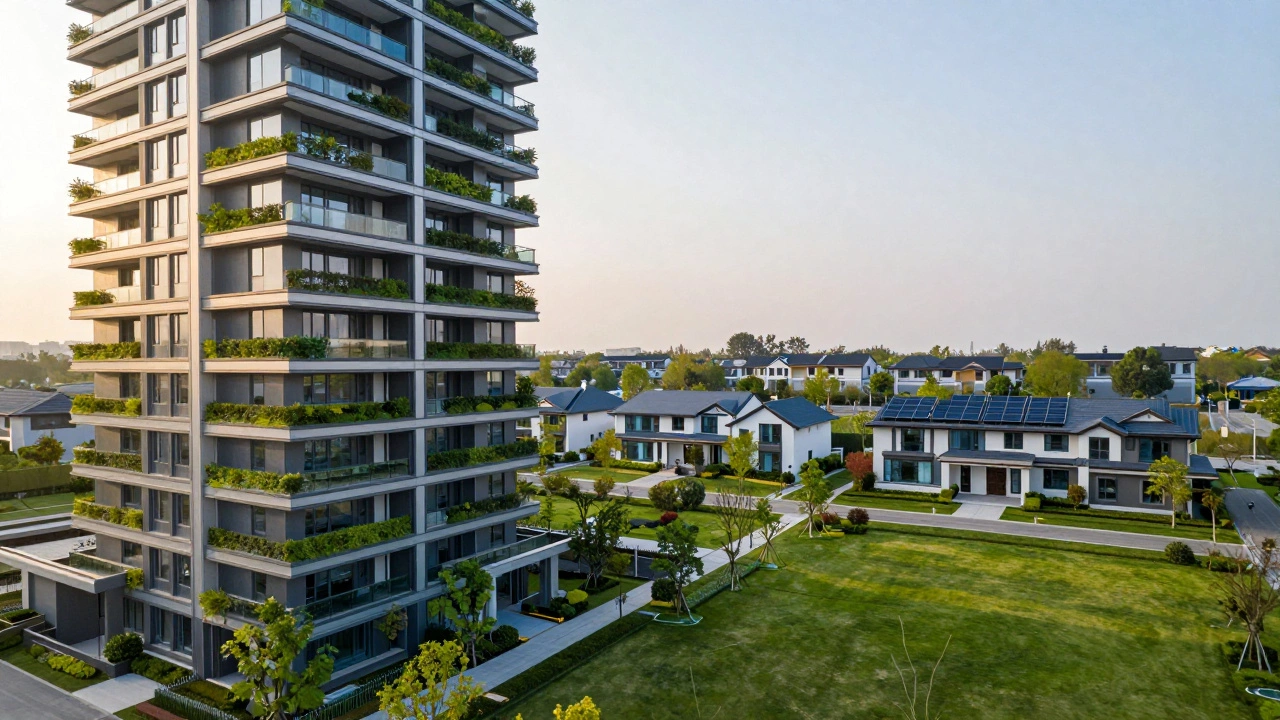
There is a persistent myth that owning a standalone home with a garden is the ultimate expression of green living. You picture solar panels on the roof, a rain barrel for the lawn, and plenty of room to grow tomatoes. But does that image hold up against the data? When you look at the actual numbers regarding energy use, land consumption, and material waste, the answer often surprises people.
In 2026, the question isn't just about which structure feels more natural; it's about which one actually minimizes your environmental impact. The truth is, an apartment is generally more eco-friendly than a single-family house, primarily because of shared walls and efficient heating systems. However, the gap is closing as new construction methods improve the efficiency of detached homes.
Why are apartments usually more energy-efficient?
Apartments share walls, floors, and ceilings with neighboring units. This means less exterior surface area is exposed to the outside elements like wind, snow, or heat. In a house, six sides are exposed to the weather, requiring significantly more energy to maintain a comfortable indoor temperature. Shared infrastructure also reduces the strain on local power grids.
Does having a garden make a house more eco-friendly?
Not necessarily. While gardens can support biodiversity, they often require water, fertilizers, and gas-powered lawnmowers, which increase your carbon footprint. If you live in an apartment, you might not have a yard, but you can still reduce your impact by choosing buildings with community green spaces or rooftop gardens.
What is the biggest environmental cost of a single-family house?
The largest cost is often 'embodied carbon'-the energy used to manufacture and transport building materials. Houses require more concrete, steel, and lumber per person than apartments. Additionally, sprawl leads to longer commutes, increasing vehicle emissions significantly.
Can a house be as eco-friendly as an apartment?
Yes, if it is built to modern passive house standards or retrofitted with high-efficiency insulation, heat pumps, and renewable energy sources. A well-insulated tiny home or a net-zero cottage can outperform a poorly insulated high-rise apartment.
How does location affect the eco-friendliness of my home?
Location matters more than the type of building. An apartment near public transit allows you to drive less, reducing overall emissions. A house in a remote suburb forces car dependency, negating any benefits from solar panels or efficient windows.
What role do heating systems play in sustainability?
Centralized heating systems in large apartment complexes are often more efficient than individual furnaces in houses. District heating networks that use waste heat from industrial processes or geothermal sources can drastically cut greenhouse gas emissions compared to burning natural gas in standalone homes.
Is it better to buy an old house or a new apartment?
It depends on the condition. Retrofitting an old house with better insulation and windows can be very sustainable if you plan to stay long-term. However, new apartments are often built with stricter energy codes, making them inherently more efficient from day one.
Do eco-friendly cottages offer a middle ground?
Yes. Modern eco-friendly cottages use sustainable materials like timber frame construction and feature compact footprints. They aim to provide the privacy of a house while minimizing resource use through smart design and renewable energy integration.
How can I make my current home more eco-friendly regardless of type?
Focus on three areas: energy efficiency (LED lights, smart thermostats), water conservation (low-flow fixtures), and waste reduction (composting, recycling). These changes apply equally to apartments and houses and yield immediate environmental benefits.
What is the future of sustainable housing?
The trend is moving toward mixed-use developments where residential, commercial, and recreational spaces coexist. This reduces travel needs and promotes walkable communities, which are far more sustainable than car-dependent suburbs.